
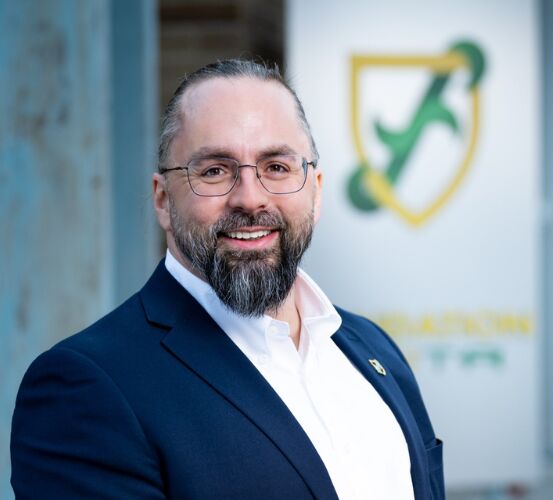
Winner of the Jean Robert Nolet Scholarship, 2025 Edition
In honor of one of its co-founders, BNP Inspire created the Jean Robert Nolet Scholarship in 2017 to support the training and professional development of philanthropy professionals and students.
In a constantly changing sector, developing skills is essential to better meet the needs of organizations and communities. Christian Bolduc, President of BNP Inspire, points out that continuing education remains one of the most powerful levers for meeting the challenges of tomorrow.
It is in this spirit that we are pleased to present our 2025 winner: Mathieu Martin, Communications and Marketing Strategist, Fondation de l’Université du Québec à Trois-Rivières
1. How would you describe the current state of the philanthropic sector?
The philanthropic sector, as I see it today, is undergoing a major transformation. We are seeing a significant decline in the number of donors, an uncertain economic climate, and increasing fragmentation of public attention. These factors represent real challenges, but I don’t see them as signs of decline. Rather, I believe that philanthropy is redefining itself.
Donors are more demanding, more informed, and want to understand the real impact of their donations, see results, and create a more personal connection with the causes they support. At the same time, I am seeing a growing commitment among a wider range of audiences: young professionals, cultural communities, and donors who are getting involved through digital and social media.
We are at a turning point where philanthropic organizations must demonstrate agility, authenticity, and transparency in order to maintain trust and mobilize support over the long term.
2. How do you see the future of philanthropy?
In my view, the future of philanthropy will be both more human and more technological.
We are moving towards a much more personalized approach, supported by data and predictive analytics tools. Micro-segmentation strategies, a detailed understanding of the donor journey, and the use of automated marketing platforms will become essential. This evolution will enable us to reach donors at the right time, with the right messages, according to their values and motivations.
But technology alone will not be enough. The heart of philanthropy remains relationships. Donors want to feel that they are more than just a number in a database. They want to be recognized, informed transparently, and above all, shown the real impact of their commitment.
This will require stronger collaboration between communications and philanthropic development teams. Philanthropy will become more consistent, more integrated, and more accessible.
3. Can you tell us about your commitment and contribution to the future of the sector?
My commitment has developed gradually, but it is always based on the same desire: to put my communication and strategy skills to work for organizations that have a real impact on their communities.
I had the opportunity to contribute to campaigns for Héritage faune, which allowed me to understand the power of good positioning, the importance of storytelling, and the challenges of mobilizing a community around a cause.
Today, at the UQTR Foundation, I work to structure our digital approaches, create engaging campaigns, and improve the donor experience. I help strengthen the bond between the foundation and its community through more targeted strategies, more human content, and more sophisticated use of data.
My contribution to the future of the sector involves:
- Continuously improving the donor experience;
- More transparent and accessible communication practices;
- A strategic approach to mobilizing and retaining donors.
I firmly believe that the philanthropy of tomorrow will be driven by those who know how to listen, understand, and build with sincerity. This is the direction in which I wish to evolve and contribute.